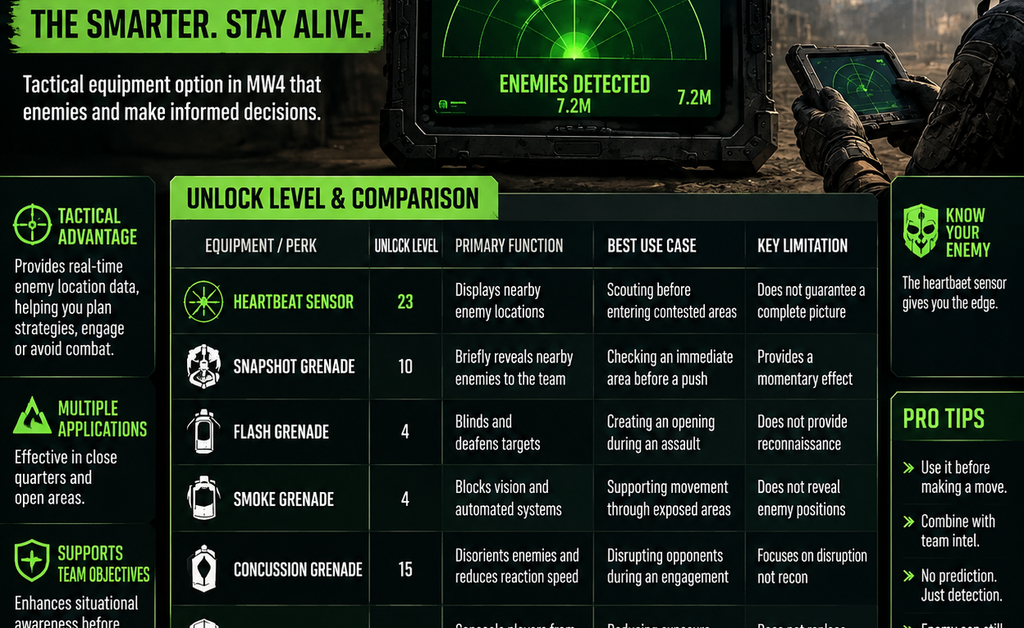
The Heartbeat Sensor is a Tactical equipment option in Call of Duty: Modern Warfare 4 that helps players identify nearby threats before committing to an engagement. Its value lies in reconnaissance rather than direct damage, making it useful for players who prefer careful movement and informed decisions. Understanding how this device fits into the wider equipment system can also help players exploring CoD MW4 DMZ Items distinguish between Multiplayer loadouts and the equipment available in DMZ.
How the Heartbeat Sensor Works in MW4
The Heartbeat Sensor is a battery-powered tablet that displays nearby enemy locations. Classified as Tactical equipment, it provides situational information that can help players assess potential threats before entering contested areas.
Its main purpose is to support decisions during uncertain encounters. Checking the surroundings before entering a building, approaching an objective, or crossing a vulnerable route can help players determine whether to advance cautiously or reconsider their approach.
However, the device should not be treated as a complete picture of the battlefield. An exact detection radius and refresh rate are not specified in the equipment description, so players should avoid assuming that every enemy will always appear on the display. Combining the sensor’s information with sound cues, map awareness, and teammate communication remains essential.
How to Unlock the Heartbeat Sensor
The Heartbeat Sensor becomes available at Player Level 23 in MW4 Multiplayer. Players can access it through the equipment progression system once they reach the required level.
The following table compares the Heartbeat Sensor with other Tactical options and the Ghost Perk, providing an overview of their unlock requirements, functions, and practical applications.
| Equipment or Perk | Unlock Level | Primary Function | Best Use Case | Key Limitation |
|---|---|---|---|---|
| Heartbeat Sensor | 23 | Displays nearby enemy locations | Scouting before entering contested areas | Does not guarantee a complete picture of enemy positions |
| Snapshot Grenade | 10 | Briefly reveals nearby enemies to the team | Checking an immediate area before a push | Provides a momentary effect |
| Flash Grenade | 4 | Blinds and deafens targets | Creating an opening during an assault | Does not provide reconnaissance |
| Smoke Grenade | 4 | Blocks vision and automated targeting systems | Supporting movement through exposed areas | Does not reveal enemy positions |
| Concussion Grenade | 15 | Disorients enemies and reduces their reaction speed | Disrupting opponents during an engagement | Focuses on disruption rather than reconnaissance |
| Ghost | 24 | Conceals players from specified enemy reconnaissance tools | Reducing exposure to enemy detection | Does not replace situational awareness |
These options serve different purposes, so the best choice depends on the situation. Flash and Concussion Grenades can provide immediate advantages during an engagement, while Smoke Grenades support movement by obstructing vision. Snapshot Grenades offer a brief reconnaissance effect, whereas the Heartbeat Sensor is designed to display nearby enemy locations.
Best Situations to Use the Heartbeat Sensor
Clearing Buildings and Tight Spaces
Buildings, corridors, and enclosed areas can create difficult engagements because opponents may be positioned around corners or in adjacent rooms. Checking the Heartbeat Sensor before entering an uncertain area can help players assess potential nearby threats and choose a more deliberate approach.
The information becomes more valuable when it changes the next decision. If the surroundings appear dangerous, players can slow their advance, check alternative entrances, or coordinate with teammates before moving forward. The sensor should complement careful clearing rather than replace it.
Supporting Objective-Based Play
In modes that require teams to capture or defend objectives, deciding when to advance can be just as important as winning the resulting gunfight. The Heartbeat Sensor can help players assess nearby threats before entering a contested area.
Defenders may use it when preparing for an incoming push, while attackers can check their surroundings before approaching a guarded position. Although the device cannot guarantee a safe entry, it can contribute to more informed decisions when combined with teammate callouts and awareness of likely enemy positions.
Checking an Area Before Rotating
Moving between objectives or crossing unfamiliar sections of a map can expose players to unexpected encounters. Checking for nearby enemies before crossing a vulnerable area may help players decide whether to continue along their current route or take another approach.
When using the sensor to support a rotation, keep these practical points in mind:
- Check for potential threats before crossing exposed areas or entering unfamiliar buildings.
- Combine sensor information with sound cues, minimap awareness, and teammate callouts.
- Avoid assuming that an area is clear simply because no enemies appear on the display.
Enemy movement can change quickly, so information from a single check should not be treated as a permanent indication that an area is safe. Maintaining awareness of surrounding routes and likely enemy positions remains important throughout the rotation.
Heartbeat Sensor Counters: Understanding the Ghost Perk
One of the most important considerations when using the Heartbeat Sensor is the availability of Ghost. This Multiplayer Perk unlocks at Player Level 24, one level after the sensor becomes available.
Ghost makes players undetectable by specified enemy reconnaissance tools, including Heartbeat Sensors. This gives players a way to reduce their visibility while creating an important limitation for those who rely on sensor information.
The absence of detected enemies does not necessarily mean an area is empty. Opponents using Ghost may avoid detection, so checking corners, watching likely entry routes, and communicating with teammates remain important even after scanning an area.
For players who prefer stealth, Ghost may be worth considering when building a loadout designed to reduce exposure to enemy reconnaissance. Choosing between reconnaissance and concealment depends on the player’s preferred role and the demands of the match.
Players experimenting with a MW4 Heartbeat Sensor loadout should consider how reconnaissance fits alongside weapon selection, movement patterns, and objective control. The equipment is most useful when its information supports a clear tactical decision rather than replacing direct observation.
Is the Heartbeat Sensor Worth Using in MW4?
The Heartbeat Sensor is worth considering for players who value information before entering uncertain engagements. It can complement a cautious playstyle, support coordinated pushes, and help players make more informed decisions around buildings and objectives. Its usefulness depends on how effectively players turn the information into better positioning and movement.
The main limitation is that reconnaissance alone does not win gunfights. Players still need effective positioning, sound awareness, accurate aim, and the ability to react when an opponent appears unexpectedly. Alternative Tactical equipment may offer more immediate benefits in situations that require disruption or visual cover.
Ultimately, the Heartbeat Sensor is a situational option rather than a mandatory choice for every loadout. Its effectiveness depends on the map, enemy positioning, and how well players use the information available to them. Players looking to buy CoD MW4 DMZ Items should evaluate their DMZ equipment needs separately, since Multiplayer loadout choices and DMZ progression serve different purposes.